
Daily Self-Care Habits That Take Less Than 5 Minutes
Key Takeaways:
✓ Self-care doesn’t have to be an hour-long ritual—tiny 1–5 minute habits can still calm anxiety, support ADHD brains, and lift low mood a little
✓ When you’re exhausted or overwhelmed, “maintenance mode” self-care (very small, repeatable actions) is more realistic than big life overhauls
✓ Pairing micro-habits with things you already do—like brushing your teeth or opening your laptop—makes them way easier to remember
✓ Research shows sleep, movement, and emotional support matter for young people’s wellness, and short actions can still help nudge those areas
✓ Simple tools like habit trackers, mood journaling, and gentle wellness apps can help your brain actually see your progress instead of forgetting it
You know that feeling when you see a “self-care routine” on TikTok and it’s like: 5am wakeup, 30-minute workout, 20-minute journal, green smoothie, 10-step skincare… and you’re just trying to remember if you drank water today?
If long routines feel impossible—especially with ADHD, anxiety, or low mood—you’re not alone. A lot of people your age are struggling with emotional wellness. National data show that about 33.8% of young adults 18–25 had some kind of emotional challenge in the past year, and only about half got support at all (SAMHSA, 2024). So if you’re tired, overwhelmed, or just “over it,” it makes sense.
This guide is about something way smaller and more doable: daily self-care habits that take less than 5 minutes, and still count.
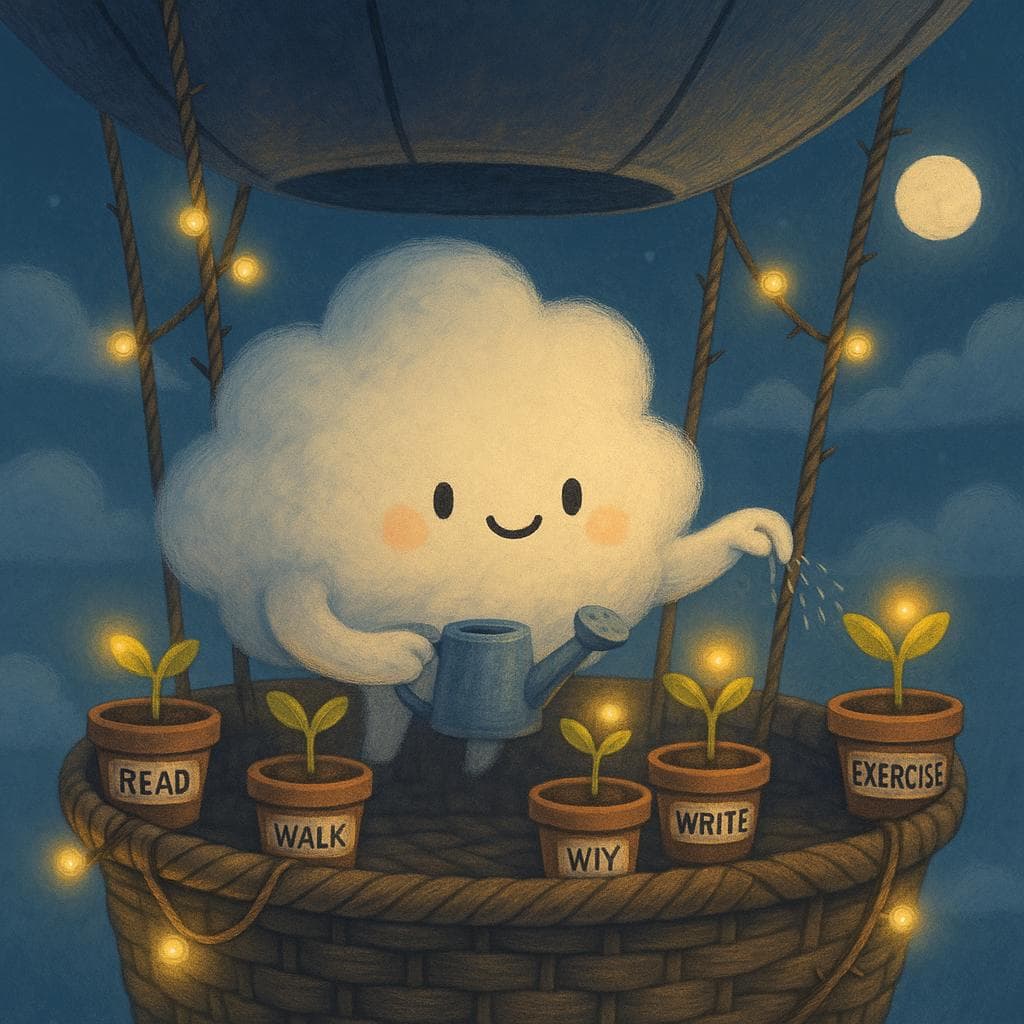
Think of them as tiny drops of water for your nervous system—just enough to keep your inner garden from drying out completely.

1. Why tiny habits work
When you’re anxious, burned out, or feeling low, your brain is not in “optimize my life” mode. It’s in “keep me alive and vaguely functioning” mode.
What’s going on in your brain
With anxiety or low mood, you might notice:
- Your energy crashes for no obvious reason
- Simple tasks (shower, dishes, replying to a text) feel huge
- Your brain tells you you’re “lazy” or “failing”
But a lot of this is your nervous system under strain, not a character flaw.
Studies show that things like sleep, movement, and emotional support are tightly connected to how you feel. For example, teens who have healthier sleep patterns are much less likely to experience strong low mood symptoms (National Sleep Foundation, 2024). And exercise has been shown to reduce anxiety and low mood in young people, even with relatively short programs (Li et al., 2023; Singh et al., 2025).
The problem: when you’re already struggling, “sleep 8–9 hours and exercise 3x a week!” can feel like being told to climb Everest in flip-flops.
That’s where tiny habits come in.
Why 1–5 minutes actually helps
Tiny habits work because they:
- Lower the starting barrier – your brain is more willing to try “1 minute” than “30 minutes”
- Create momentum – once you start, you sometimes naturally keep going
- Build evidence – they give you proof you can care for yourself, even on bad days
You’re not trying to become a brand-new person overnight. You’re just nudging your system a few centimeters toward “slightly less awful.”
Quick comparison
| Big routine expectation | Tiny habit version | Why tiny wins |
|---|---|---|
| 30-min workout daily | 2-minute stretch | Easier to start, still moves your body |
| 20-min journal | 1 sentence check-in | Builds awareness without pressure |
| Full cleaning session | Clear one surface | Reduces chaos in your field of view |
| 1-hour bedtime routine | 3-minute wind-down | Signals “we’re closing the day” |
You’re allowed to be in “maintenance mode.” Tiny is still valid.
2. 5-minute body resets
When your brain is overwhelmed, your body usually is too. These under-5-minute habits help you reset just enough to keep going.
One-glass reset
What it is: Drink one full glass of water, slowly and intentionally.
How to do it (2–3 minutes):
- Fill a glass or bottle.
- Sit or stand still while you drink—no scrolling.
- Notice the temperature, the swallowing, the small pause.
When to use it:
- Right after you wake up
- Between classes or meetings
- When your head feels foggy or you’re getting a headache
You’re not trying to become a hydration influencer. You’re just giving your body one clear “I care about you” signal.
Micro stretch break
What it is: A 2–4 minute movement reset you can do in your room, library, or bathroom stall.
Try this combo:
- Roll your shoulders back 5–10 times
- Gently stretch your arms overhead and lean side to side
- Roll your neck slowly in a small circle
- Shake out your hands and feet for 10–20 seconds
Research shows movement can ease anxiety and low mood in young people (Singh et al., 2025). This isn’t a full workout, but it still tells your nervous system, “We’re not stuck. We can move.”
Temperature change trick
Sometimes your body needs a quick “pattern interrupt.”
Ideas (1–3 minutes):
- Splash cool water on your face
- Hold a warm mug with both hands
- Step outside for 2 minutes of fresh air
- Put a cool cloth on the back of your neck
These tiny shifts can help your system reset just enough to think more clearly for the next task.
Example:
You’re doomscrolling between classes, feeling your anxiety spike. Instead of trying to “calm down” with positive thoughts, you walk to the bathroom, splash cool water on your face, take 3 slow breaths, and then head to your next class.
Nothing magical happened—but you broke the spiral and gave your body a quick reset.
If you want more ideas for short body-based resets, you might like our guide on stress management tools that actually work for students.
3. 5-minute mind resets
Your thoughts can snowball fast—especially with anxiety or ADHD. These habits help you gently grab the snowball before it becomes an avalanche.
The 3-breath pause
What it is: A super short breathing reset that doesn’t feel like a whole meditation session.
How to do it (1–2 minutes):
- Inhale through your nose for a count of 4
- Hold for a count of 2
- Exhale slowly through your mouth for a count of 6
- Repeat 3 times
That’s it. Three breaths. If your mind wanders, that’s fine. The point is the doing, not doing it perfectly.
One-line mood check
A lot of people think journaling has to be pages of deep reflection. It doesn’t.
Try this (1 minute):
- Open your notes app or a paper
- Write: “Right now I feel ___ because ___.”
Examples:
- “Right now I feel wired because I have three deadlines.”
- “Right now I feel numb because today was just… a lot.”
This is a tiny version of mood journaling. It helps you notice what’s going on instead of just marinating in vague “everything sucks” energy.
If you’re curious how journaling actually helps, we broke it down in how journaling actually helps your wellbeing (and why it’s not what you think).
The “name 3 things” grounding
When your thoughts are racing, bring your attention back to your senses.
In 2–3 minutes:
- Look around and name 3 things you can see
- Notice 3 things you can feel (clothes on skin, feet on floor, air on face)
- Notice 3 sounds you can hear, even faint ones
You’re not trying to erase your thoughts—just giving your brain another channel to tune into for a moment.
2-minute brain dump
ADHD and anxiety both love to create “mental tabs” that never close.
Quick brain dump (2–5 minutes):
- Set a 2–3 minute timer
- Write down everything on your mind: tasks, worries, random thoughts
- When the timer ends, stop. Circle 1 thing that matters today
You don’t have to solve everything you wrote. You just moved it from brain → page, and picked one tiny focus. That’s already a win.
4. 5-minute connection habits
Humans are wired for connection, but reaching out can feel exhausting—especially when you’re low or anxious.
The good news: connection doesn’t have to mean a 2-hour FaceTime. Even tiny check-ins can support your emotional wellbeing. In fact, national data show that teens who feel more connected to school and people around them report fewer persistent sadness symptoms (CDC, 2024). Small connections matter.
The 30-second text
What it is: A quick “touch base” message that doesn’t require a full conversation.
Templates you can steal:
- “Thinking of you, how’s your week going?”
- “Zero energy to talk, but wanted to say hi and I appreciate you.”
- “My brain is fried but I’d love a meme if you have one.”
This takes under a minute and reminds both you and them that you’re not alone.
Parallel hangout plan
If socializing feels draining, try “parallel” time instead of full-on hanging out.
In under 5 minutes, you can:
- Text a friend: “Want to co-work on Zoom for 30 mins later? Cameras optional.”
- Ask a roommate: “Want to sit in the same room and do our own thing for a bit?”
- Send: “Can we call later and just exist on the phone while we scroll?”
You’re creating connection without the pressure to be “on.”
Ask-for-support script
Asking for help is hard, especially if you’re the “independent one.” But you don’t have to give a full TED Talk about your feelings.
Try a 1–2 sentence script:
- “I’ve been feeling off lately and could use some low-pressure company this week.”
- “My anxiety’s been loud. Can I vent for 5 minutes later?”
We go deeper on this in why asking for help feels so uncomfortable when you’re the independent one, but even a tiny reach-out is a real act of self-care.
5. 5-minute environment upgrades
Your space affects your brain more than you think—especially if you’re already struggling. The goal isn’t a full aesthetic makeover; it’s tiny shifts that make your environment 1% kinder.
One-surface rule
What it is: Instead of “clean your whole room,” you choose one small surface to reset.
Options:
- Your desk
- Your nightstand
- The part of the floor you see first when you wake up
In 3–5 minutes:
- Throw away visible trash
- Put dishes in the sink
- Stack or pile the rest neatly (it doesn’t have to be perfect)
You’re not aiming for “Pinterest clean.” You’re just giving your brain one clear area to rest on.
Light and air check
Quick ways to make your space feel less like a cave:
- Open curtains or blinds a bit
- Turn on a warm lamp instead of harsh overhead light
- Crack a window for 2–3 minutes if possible
It sounds small, but changing light and air can shift your energy just enough to make the next task feel slightly less impossible.
Prepare-one-thing-for-future-you
Think of this as planting a tiny seed for tomorrow.
Ideas (2–4 minutes):
- Lay out tomorrow’s clothes (even just sweatpants and a t-shirt)
- Put a snack or instant meal where you’ll see it when you’re hungry and tired
- Pack your bag with the one thing you always forget
You don’t need to be organized in every area of life. You’re just choosing one spot to be kind to future you.
6. Turning tiny habits into a routine
The magic isn’t in any single 5-minute habit. It’s in repeating a few of them, most days, in a way that fits your actual life and brain.
Habit stacking (ADHD-friendly)
One of the easiest ways to remember tiny habits is to attach them to stuff you already do.
Formula:
“After I ___, I will ___ for 1–3 minutes.”
Examples:
- After I brush my teeth, I will do a 3-breath pause.
- After I open my laptop, I will do a 2-minute brain dump.
- After I get into bed, I will write one-line mood check.
You’re not adding a whole new routine; you’re piggybacking on existing ones.
Pick your “daily 3”
Instead of trying to do everything in this article, choose just three tiny habits as your base routine.
Example daily 3:
| Moment | Tiny habit | Time |
|---|---|---|
| Morning | One-glass reset | 2–3 min |
| Afternoon | Micro stretch break | 2–4 min |
| Night | One-line mood check in notes | 1–2 min |
If you miss a day (or five), that doesn’t erase anything. You’re tending a garden, not taking a pass/fail exam.
Track effort, not perfection
ADHD and anxious brains are great at forgetting what went well and obsessing over what didn’t.
Simple tracking can help:
- Put a tiny dot on your calendar each day you do one habit
- Use a habit tracker or wellness app to log your “daily 3”
- Jot down “I did: water / stretch / text” in your notes app
You’re building a record your brain can’t argue with: proof that you are showing up for yourself, even in small ways.
7. Bringing it all together
You don’t need a 2-hour morning routine, a fancy gym membership, or a perfect bullet journal to take care of yourself.
You just need:
- A few tiny habits that take less than 5 minutes
- A rough idea of when you’ll do them
- Enough self-compassion to keep going when you inevitably drop them sometimes
One simple way to start today:
- Pick one body reset from Section 2
- Pick one mind reset from Section 3
- Pick one environment or connection habit from Sections 4–5
Try those three tiny actions sometime in the next 24 hours. That’s it. No overhaul, no “new you,” just a slightly kinder day.

8. Conclusion
If long self-care routines make you feel more guilty than grounded, you’re not the problem—the advice is. Your brain and life might need something smaller, softer, and more flexible.
Tiny, under-5-minute habits won’t fix everything. Nothing will. But they can:
- Make it a little easier to get through the day
- Give your nervous system tiny breaks instead of none
- Remind you that you’re worth caring for, even when you’re struggling
If you want a gentle place to keep track of these small actions and actually see your progress grow over time, you can download Melo and start tending your own little wellness garden—one 5-minute habit at a time.
Note: This article is for information and support only and isn’t a substitute for professional care. If your anxiety, low mood, or other emotional struggles are making it very hard to function, reaching out to a therapist, counselor, or other trusted professional for more personalized support can really help.