
Imposter Syndrome in College and Early Career
If you’ve ever sat in a lecture or a Zoom meeting thinking, “Everyone is smarter than me and it’s only a matter of time before they find out,” you’re not alone. That “I must have tricked my way in here” voice has a name: imposter syndrome.
It shows up hard in college and early career, especially if you’re juggling anxiety, ADHD, low mood, or you’re the first in your family to be in these spaces. The wild part? It usually hits the people who are actually doing well.
This guide breaks down what imposter syndrome really is, why it hits so many students and young adults, and tiny, doable ways to start tending to your confidence—without pretending everything is fine.
Key Takeaways:
✓ Imposter syndrome is extremely common in college and early career, especially for high achievers, first-gen students, neurodivergent folks, and people from marginalized groups
✓ Your brain often ignores real evidence of your skills and zooms in on every tiny mistake—learning to notice and question that bias is a game changer
✓ ADHD and anxiety can supercharge imposter thoughts by making focus, memory, and performance feel inconsistent or “unreliable”
✓ Tiny habits like a 1-sentence mood journal, a “wins” list, or asking one small question in class can slowly rewire how you see yourself
✓ You don’t have to fix imposter syndrome alone—friends, professors, mentors, campus counseling, and wellness tools can all be part of your support system

1. Why imposter syndrome hits now
College and early career are basically a perfect storm for feeling like a fraud.
You’re suddenly surrounded by new people, new rules, and new expectations. You might be away from home, paying a lot of money for school, or in your first “real” job where every email feels like it could ruin your life.
Big transitions, big doubt
Research shows that late teens and early 20s are a critical window for emotional challenges—“half of all mental illness begins by age 14 and three-quarters by age 24” (American Psychiatric Association, 2024). That means a lot of people are dealing with anxiety, low mood, or other struggles right when they’re supposed to be “launching” into adult life.
On top of that:
- Grades suddenly feel like they “define” your future
- Internships and jobs are competitive
- Social media is a nonstop highlight reel of everyone else’s wins
Put all that together and it’s easy for your brain to decide: “I’m the one who doesn’t belong.”
It’s not just you being “insecure”
Imposter syndrome isn’t just about “low confidence.” It’s a pattern where you:
- Explain away your achievements (“I just got lucky,” “They probably needed diversity,” “They lowered the bar”)
- Feel like you’re faking competence, even when you’re doing fine
- Live with constant anxiety that you’ll be “found out”
- Set impossibly high standards and then beat yourself up for not hitting them
And here’s the kicker: a lot of people who feel this way are actually performing above average. Your brain just refuses to update its story.
Systemic stuff matters
You’re not imagining it if imposter syndrome hits harder when:
- You’re a student of color in a mostly white program
- You’re LGBTQ+ in a space that doesn’t feel fully safe
- You’re first-gen and everyone else seems to “know the rules”
- You have ADHD or another neurodivergent brain and traditional systems weren’t built for you
“LGBTQ+ teens and teens of colour are significantly less likely than white, non-LGBTQ+ peers to report receiving the social/emotional support they need” (CDC/APA, 2023–2024). When support is uneven, feeling like you’re the “only one struggling” is almost guaranteed.
You’re not broken. The system is confusing, uneven, and often biased. Imposter syndrome is your brain trying (badly) to make sense of that.
In summary:
- Big transitions + uneven support + constant comparison = perfect imposter storm
- Imposter syndrome is common and especially hits people who are already under extra pressure
- It’s not proof you don’t belong—it’s a reaction to a tough environment
2. How ADHD, anxiety, and low mood amplify it
If you deal with anxiety, ADHD, or low mood, imposter syndrome can feel like it’s on “hard mode.”
Anxiety’s “fraud detector”
Anxiety is now the most common diagnosed condition in U.S. adolescents—about 16% have a current anxiety diagnosis (HRSA/NIH, 2024). Many of those teens become anxious college students and young adults.
Anxiety loves to:
- Predict the worst possible outcome
- Rewind every conversation and pick apart what you said
- Turn normal mistakes into “evidence” that you’re incompetent
So instead of, “I got nervous in that presentation,” anxiety says, “You’re clearly not cut out for this field.”
ADHD and inconsistent performance
If you have ADHD, you might notice:
- Some days you’re hyper-focused and crush everything
- Other days, basic tasks feel impossible
- You miss small details or deadlines even when you care a lot
That inconsistency can feed imposter thoughts like:
- “If I were really smart, I wouldn’t need extensions.”
- “Everyone else can just sit and focus—what’s wrong with me?”
In reality, your brain is wired differently. Tasks that are boring or overwhelming are harder to start. That’s not a moral failure; it’s a brain thing. But imposter syndrome doesn’t know that—it just sees “not matching the norm” and calls it “fake.”
Low mood and “nothing I do counts”
Low mood can make your inner critic feel even louder. When you’re feeling down, your brain tends to:
- Dismiss your wins
- Zoom in on your flaws
- Assume other people secretly think you’re a disappointment
“From 2013 to 2023, the share of U.S. high school students reporting persistent sadness or hopelessness rose from about 30% to about 40%” (CDC, 2024). A lot of students are carrying that persistent sadness straight into college and early jobs.
If you already feel like “nothing I do matters,” imposter thoughts land fast and hard.
In summary:
- Anxiety makes you overestimate threats and underestimate yourself
- ADHD makes performance more up-and-down, which can look like “faking it” even when it’s not
- Low mood makes it hard to see your strengths or believe praise
3. Spotting imposter thoughts in real life
Naming what’s happening is a powerful first step. Here’s how imposter syndrome often shows up day-to-day.
In class
- You avoid asking questions so people don’t “find out” you’re confused
- You over-prepare for every assignment and still feel unprepared
- A single bad grade makes you question your entire major
Example:
The professor asks for volunteers to share their project idea.
Your brain: “Everyone else has real ideas. Mine is basic. If I speak, they’ll know I don’t belong here.”
You stay quiet, even though your idea is solid.
In group projects
- You do most of the work but give others all the credit
- You assume you’re the “weak link,” even without evidence
- You apologize constantly for “not doing enough,” even when you are
In internships or first jobs
- You reread emails 10 times to make sure you don’t sound “stupid”
- Normal feedback feels like a sign you’re about to be fired
- You feel like you “tricked” your way into the role and HR will realize the mistake any day now
Online and social media
- You compare your behind-the-scenes to everyone else’s highlight reel
- You see posts about promotions, grad school, or perfect GPAs and think, “I’m falling behind”
- You feel like you have to “perform” competence 24/7
Quick self-check:
If you relate to any of these patterns and you have actual evidence that you’re doing okay (passing classes, getting invited back, receiving neutral or positive feedback), imposter syndrome is likely in the mix.
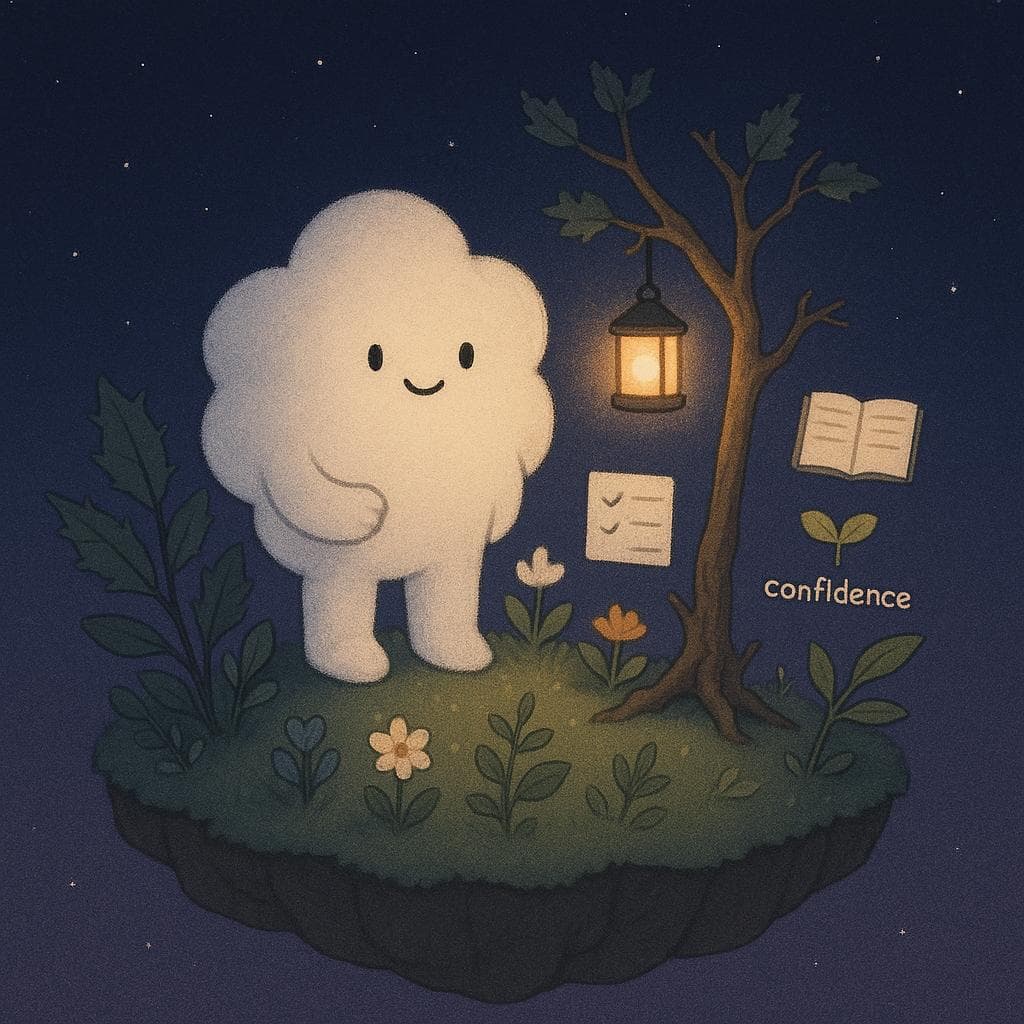
4. Tiny ways to challenge the “fraud” story
You don’t have to fully believe in yourself to start changing how you respond to imposter thoughts. You just need tiny, repeatable actions.
Start a 1-sentence “evidence log”
Your brain keeps a detailed file of your mistakes and completely forgets your wins. Let’s rebalance that—very gently.
- Open your notes app or a physical notebook.
- At the end of the day, write one sentence of evidence that you’re not a fraud.
Examples:
- “I answered one question correctly in class today.”
- “My manager said ‘nice work’ on that email.”
- “I didn’t understand the reading at first, but I reread it and got the main idea.”
That’s it. One sentence. Over time, this becomes a little garden of proof you can look back on when your brain says, “You’ve never done anything right.”
Use “I’m having the thought that…”
Instead of “I am a fraud,” try “I’m having the thought that I’m a fraud.”
It sounds small, but it creates a tiny bit of distance between you and the thought.
- “I’m having the thought that I don’t belong in this program.”
- “I’m having the thought that my coworkers secretly hate my work.”
You’re not arguing with the thought (yet). You’re just noticing it as a thing your brain is saying—not an automatic truth.
Practice “good enough” work
Imposter syndrome often demands perfection. For one small task, try aiming for “good enough” instead of “flawless.”
Pick something low-stakes:
- A discussion board post
- A short email
- A draft of a slide
Then:
- Give yourself a time limit (10–20 minutes).
- Do your best within that time.
- Send or submit it, even if your brain screams “not ready.”
Over time, you teach your nervous system that:
- Imperfect work is still valid
- You can survive not polishing everything 100 times
- Other people often accept and even like your “good enough” work
Ask one tiny question
If speaking up feels terrifying, shrink the goal.
- In class: ask one clarifying question per week (or per month to start)
- At work: ask, “Just to confirm, is this the priority?” or “Can you show me an example?”
You’re not exposing yourself as a fraud—you’re doing what actual competent people do: get clarity.
In summary:
- You don’t have to fully “believe in yourself” to start changing your habits
- One-sentence logs, tiny questions, and “good enough” experiments are small but powerful
- The goal is to gently collect evidence that your imposter story is incomplete
5. Building a gentle anti-imposter routine
Imposter syndrome calms down when you consistently collect proof that you’re capable and allowed to learn. That’s where tiny routines come in.
A simple daily check-in
Here’s a 3-minute check-in you can do most days:
| Step | Question | Example answer |
|---|---|---|
| 1 | What’s one thing I tried today? | “I spoke once in lab.” |
| 2 | What’s one thing I learned (even if I messed up)? | “I learned how to format that document correctly.” |
| 3 | What’s one way I showed up for myself? | “I emailed my professor instead of silently panicking.” |
You can do this in a mood journal, notes app, or even as a voice memo. It’s like watering your self-trust a tiny bit each day.
If you want more ideas for low-pressure journaling, check out this guide on how journaling actually helps your wellbeing.
Micro-habits for confidence
Here are a few 1–5 minute habits that support you when imposter feelings spike:
-
Name the skill, not just the result
- Instead of “I got an A,” try “I practiced time management and broke the assignment into chunks.”
-
Set “minimums,” not just “ideal goals”
- Ideal: “Study 3 hours.”
- Minimum: “Open the notes and review 1 page.”
-
Use body-based resets
When anxiety is loud, your body needs care too. Try:- 3 slow exhales, longer than your inhales
- Standing up and stretching for 30 seconds
- Putting a hand on your chest and saying, “This is hard, and I’m still here.”
-
Schedule one “learning moment” per week
- Watch a short tutorial
- Attend office hours for 10 minutes
- Ask a coworker, “How do you usually handle X?”
These aren’t about becoming perfect. They’re about building a quiet pattern: “I’m someone who keeps learning and trying.”
When you “fail”
Imposter syndrome loves to show up when:
- You bomb a test
- You get critical feedback
- You forget a deadline
Instead of jumping straight to “I’m a fraud,” try this 3-step reset:
-
Fact-check:
- What exactly happened? (One test? One project? One comment?)
-
Context-check:
- Were you sleep-deprived, overwhelmed, or juggling too much?
- Did you have the information and support you needed?
-
Next-step:
- What’s one small repair move? (Email the professor, ask for clarification, adjust your study plan, set a reminder.)
You’re allowed to be a real human who messes up and still belongs.
If you want more help with resting instead of spiraling after setbacks, this guide on how to rest when you feel guilty about resting might help.
In summary:
- Tiny, repeatable habits slowly retrain your brain to see your effort and growth
- “Minimums” and micro-habits are especially useful if you have ADHD or low energy
- Mistakes become data and direction, not proof you’re a fraud

6. Getting support without shame
You don’t have to untangle imposter syndrome alone. In fact, hearing “me too” from others is one of the fastest ways to realize how common it is.
Talk to people who see you clearly
Consider sharing what you’re feeling with:
- A trusted friend or roommate
- A classmate who seems honest (not just competitive)
- A mentor, advisor, or RA
- A coworker who’s a bit ahead of you in their career
You don’t need a speech. You can start with:
- “I keep feeling like I don’t belong here, even though I’m passing.”
- “Does it ever feel like you just got lucky getting this job?”
You’ll be surprised how many people say, “All the time.”
Use campus or workplace resources
“On many campuses, about one in four students has used on-campus counseling and around 12% have used tele-counseling services” (American Psychiatric Association, 2023). And still, “about two-thirds of college students report not using any campus mental health resources at all” (American Psychiatric Association, 2023).
If you’re in school, you’re likely paying for counseling and wellness resources through your fees—even if you never walk in the door.
You can look into:
- Counseling services (often free or low-cost)
- Workshops on anxiety, perfectionism, or study skills
- Peer support groups or affinity spaces
If you want a real-world breakdown of how to actually use these services, this guide on making the most of campus counseling can help.
If you’re working, check whether your company has:
- Employee assistance programs (EAPs)
- Coaching or mentorship programs
- Affinity groups (e.g., for first-gen, LGBTQ+, or employees of color)
When you can’t afford therapy (or it feels out of reach)
“Despite need, 20% of U.S. adolescents reported having unmet mental health care needs in the past year” (CDC, 2025). Many young adults still can’t access or afford regular therapy.
If you’re in that boat, you’re not failing at self-care. The system is not built for everyone. You can still get support through:
- Campus counseling (even if you’re part-time)
- Sliding-scale community clinics
- Supportive friends, professors, or mentors
- Wellness tools like mood journals, habit trackers, and gentle wellness apps that act as a kind of therapy alternative when you can’t afford therapy or don’t have insurance
None of these replace professional care, but they can help you cope with difficult feelings, track patterns, and build daily self care routines that make imposter thoughts less overwhelming.
7. Conclusion: You belong here, even when your brain disagrees
Imposter syndrome in college and early career isn’t a sign that you’re in the wrong place. It’s often a sign that:
- You’re stretching into something new
- You care a lot about doing well
- You’re in systems that weren’t designed with everyone in mind
Your brain might be yelling, “You’re faking it,” but the evidence—your effort, your tiny wins, your willingness to keep showing up—tells a different story.
One small next step:
Tonight or tomorrow, write one sentence of evidence that you’re not a fraud. Just one. Maybe it’s “I showed up to class even though I wanted to hide,” or “I asked for help instead of pretending I understood.” That sentence is a seed. You don’t have to believe in the whole garden yet. Just plant this.
Over time, those small actions—questions asked, drafts submitted, breaks taken, feelings named—add up. You’re not “tricking” your way through life. You’re learning, growing, and tending to yourself in a world that makes that harder than it needs to be.
If you’d like a gentle place to keep track of those tiny wins and see them grow over time, Melo Cares can help you tend to yourself like a small, patient garden—one little sprout of self-trust at a time.
Note: This article is for general information and support only. It isn’t a substitute for professional care. If imposter feelings, anxiety, or low mood are making it very hard to function day-to-day, consider reaching out to a counselor, therapist, or healthcare provider for more personalized help.