
Imposter Syndrome in College and Early Career: How to Stop Feeling Like a Fraud
If you’ve ever opened your grade report, seen an A, and immediately thought, “They must’ve graded this wrong,” you’re in the right place.
Imposter syndrome in college and early career hits especially hard when everyone around you seems confident, productive, and “built for this” — while you’re quietly waiting for someone to realize you have no idea what you’re doing.
You’re not alone, and you’re definitely not broken. You’re bumping up against a very human reaction to a pretty intense system.
Key Takeaways:
✓ Imposter syndrome is common in college and early career, especially for high achievers, first-gen students, marginalized folks, and people with ADHD or anxiety
✓ Your brain is running unhelpful “fraud” stories, not reporting facts — learning to name and question those stories is a powerful first step
✓ Tiny, repeatable actions (like saving “receipts” of your wins or practicing neutral self-talk) work better than trying to “feel confident” overnight
✓ Systems around you — perfectionism culture, unclear expectations, bias — feed imposter feelings, so this is not just a personal failing
✓ You can build a gentle routine to work with imposter thoughts while still doing the things that matter to you, even if confidence hasn’t caught up yet

1. What imposter syndrome really is
Imposter syndrome isn’t an official diagnosis. It’s a pattern: you achieve things, but your brain refuses to let you feel like you deserve to be there.
Common thoughts
See if any of these sound familiar:
- “I just got lucky.”
- “If they knew how much I procrastinate, they’d never trust me.”
- “Everyone else understands this. I’m faking it.”
- “They’re going to realize I don’t belong here.”
You might respond to praise by:
- Downplaying it (“It was nothing, anyone could’ve done it”)
- Pointing out flaws (“Yeah, but I turned it in late”)
- Mentally rewriting history (“I only got picked because no one else wanted it”)
Why it hits now
College and early career are basically “imposter syndrome starter packs”:
- You’re constantly doing new things you’ve never done before
- Expectations are high but often vague
- You’re surrounded by people you compare yourself to 24/7 (in person + online)
- You rarely see others’ doubts — just their highlight reels
Research shows many serious emotional challenges first show up in late teens and early 20s, making this a critical window for support (American Psychiatric Association, 2024). So if your anxiety or low mood spiked around this time, that tracks with what a lot of people experience.
This doesn’t mean something is wrong with you. It means you’re in a high-pressure season where your brain is trying (and failing) to keep you safe by yelling, “Don’t mess up!”
Quick reframe
Imposter syndrome isn’t proof you’re unqualified.
It’s proof you’re:
- Aware of the stakes
- Still learning (which… is the whole point of college and early jobs)
- Probably holding yourself to a harsher standard than anyone else
2. Why your brain does this
Understanding what’s happening doesn’t make it vanish, but it can make it less personal.
The perfectionism trap
College and early career culture often reward perfection:
- 4.0 GPAs
- “Crushed it” presentations
- Being “always on” at work
You rarely get credit for:
- Asking for help
- Taking breaks
- Learning slowly
Over time, your brain quietly builds a rule:
“If it’s not flawless, it doesn’t count.”
So even when you do well, your brain finds a loophole:
- “It was easy, so it doesn’t count.”
- “I got an extension, so it doesn’t count.”
- “Someone helped me, so it doesn’t count.”
ADHD, anxiety, and imposter feelings
If you have ADHD or anxiety (diagnosed or not), imposter syndrome can feel extra loud.
ADHD can mean:
- Last-minute sprints instead of steady work
- Forgetting small tasks but nailing the big ones
- Needing more structure than others
Anxiety can mean:
- Overthinking every email or assignment
- Replaying conversations and “mistakes” at night
- Assuming people are secretly disappointed in you
When you work differently from the “ideal student/employee” stereotype, it’s easy to assume you’re behind — even when your results are good.
If this feels familiar, you might also like our guide on managing academic stress without losing your mind.
Systems, not just self
It’s important to say this clearly: imposter syndrome doesn’t exist in a vacuum.
- First-gen students are often figuring things out without a roadmap
- Students of color, LGBTQ+ folks, and other marginalized groups are navigating bias on top of everything else
- Many young adults are dealing with anxiety, low mood, or other emotional challenges — in 2023, about a third of young adults 18–25 had some kind of emotional challenge that met criteria for a condition (SAMHSA, 2024)
When the environment keeps sending “you don’t belong” signals, of course your brain starts to believe it.
You’re not just “too sensitive.” You’re responding to real pressures.
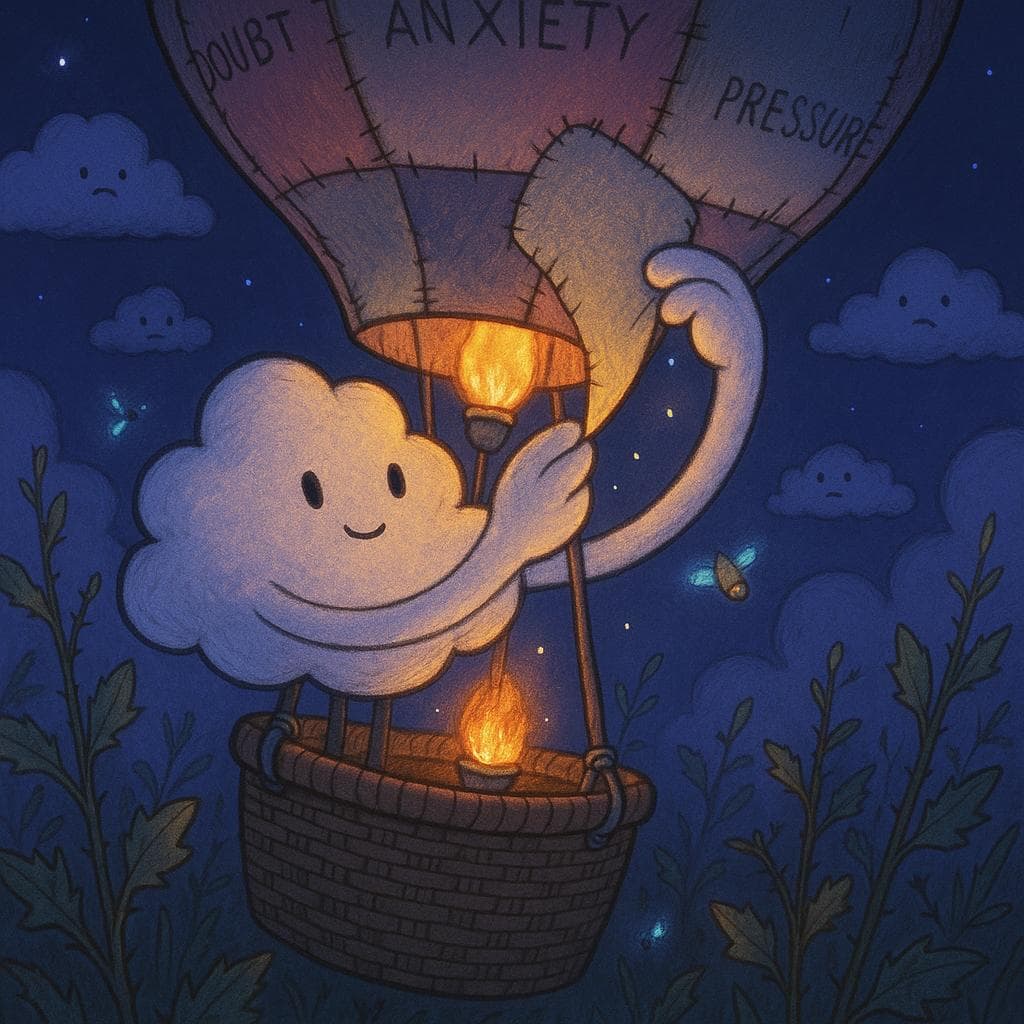
3. Catching imposter thoughts in real time
You can’t change what you don’t notice. Step one is learning to spot imposter thoughts when they show up.
Name the pattern
Next time your brain goes, “You’re a fraud,” try this:
Step 1: Label it
- “Oh, this is my imposter brain talking.”
- “That’s an imposter thought, not a fact.”
Step 2: Separate feeling from fact
Ask yourself:
- “What are the actual facts here?”
- “What would I say to a friend in my exact situation?”
Example:
“I only got this internship because they were desperate.”
Facts: you applied, interviewed, and they chose you over other people. That’s data, not desperation.
You’re not trying to convince yourself you’re amazing. You’re just trying to stop treating every anxious thought as the truth.
Use a simple thought check
Here’s a quick 3-question filter you can keep in your notes app:
- What am I telling myself right now?
- What evidence supports this?
- What evidence doesn’t fit this story?
Even if you can’t fully believe the new story yet, writing it out pokes holes in the “I’m a fraud” narrative.
This is similar to some basic CBT (cognitive-behavioral) skills — which have strong evidence for helping with anxiety in young people (APA/CBT practice guides, 2022–2025). If you want to go deeper on those skills, check out our post on CBT techniques you can practice on your own.
4. Tiny actions to shrink imposter syndrome
You don’t need a full personality makeover. You need small, repeatable actions that slowly rewire how you see yourself.
Here are some that take 1–5 minutes.
Start a “receipts” file
Imposter syndrome thrives on forgetfulness. Your brain deletes your wins and keeps your mistakes in 4K.
Fight back with a low-effort “receipts” system.
- Create a note called “Evidence I Don’t Suck”
- Every time something goes even slightly well, drop in one line:
- “Prof said my question was ‘insightful’.”
- “Coworker thanked me for catching that typo.”
- “Finished assignment even though I wanted to ghost it.”
On bad days, scroll through. You’re building a record your anxious brain can’t easily argue with.
This is also a gentle form of mood journaling — one of the most helpful tools for building emotional awareness. We break down more approaches in how journaling actually helps your wellbeing.
Practice “neutral, not negative” self-talk
You don’t have to jump from “I’m a fraud” to “I’m a genius.” Aim for neutral.
Swap these:
-
❌ “I have no idea what I’m doing.”
-
✅ “I’m still learning how this works.”
-
❌ “I only got in by mistake.”
-
✅ “They accepted me based on what I showed them.”
-
❌ “Everyone is smarter than me.”
-
✅ “People here have different strengths. So do I.”
Neutral statements feel less fake than positive affirmations, but they still calm your nervous system.
Set “good enough” rules
Perfectionism feeds imposter syndrome. Try setting “good enough” standards in advance.
For example:
- “This email is done when it’s clear and polite, not perfect.”
- “This assignment is done when I’ve spent 3 focused hours, even if I could tweak more.”
- “This presentation is done when I’ve practiced twice, not until I feel 100% confident (which may never happen).”
You can even write these rules on a sticky note above your desk as a reminder when your brain wants to spiral.
Use tiny exposure
Imposter syndrome often makes you avoid situations where you might be “found out” — asking questions, applying for roles, speaking up.
Instead of forcing yourself into huge scary moments, try tiny exposures:
- Ask one question in class or a meeting, even if your voice shakes
- Send one message to a professor or manager asking for clarification
- Volunteer for a small task, not the whole project
Each time you survive a tiny risk, your brain learns: “Oh, I can do that and the world doesn’t end.” That’s exposure in action — a core piece of many anxiety treatments (APA/CBT practice guides, 2022–2025).
Track effort, not just outcomes
Imposter syndrome only respects outcomes: grades, titles, praise.
You can gently retrain your brain to also notice effort:
- Log “study blocks” instead of only test scores
- Note “I showed up to office hours” even if it felt awkward
- Celebrate “I submitted something” even if it wasn’t your best work
A simple habit tracker — even just ticking off “I worked on this for 20 minutes” — can help your brain see the process, not just the final result.
5. College vs early career imposters
Imposter feelings can look a little different depending on where you are.
In college
Common patterns:
- Feeling like admissions “made a mistake”
- Assuming everyone else has a study system and you’re just winging it
- Comparing how much you feel like you’re struggling to how put-together others look
You might:
- Overwork to “prove” you belong
- Avoid office hours because you’re scared of being exposed
- Stay quiet in discussions even when you have ideas
In early career
New flavor, same brain:
- “They’re going to realize I’m not worth my salary.”
- “I should know this already.”
- “I’m too slow; they hired the wrong person.”
You might:
- Over-prepare for everything
- Answer emails instantly to seem “on it”
- Avoid asking questions because you “should already know”
Here’s a quick comparison:
| Context | Common Imposter Thought | Tiny Reframe |
|---|---|---|
| College class | “I don’t belong at this school.” | “They accepted me based on real info about me.” |
| Group project | “I’m dragging everyone down.” | “I bring X strength; others bring theirs.” |
| First job | “I’m too slow at this.” | “I’m new. Speed comes with reps.” |
| Internship | “They regret hiring me.” | “They’re investing time in teaching me.” |
You can’t stop the first thought from popping up. You can practice offering a second thought on purpose.

6. Building a gentle anti-imposter routine
You don’t need a 20-step self care routine. Think of this like tending a plant: a little, consistently, is better than a lot, once.
Here’s a simple daily or weekly flow you can adapt.
Daily (3–5 minutes)
-
Morning check-in (30–60 seconds)
Ask: “What’s one thing today my imposter brain might freak out about?”
Then: “What’s one tiny way I can support myself through that?”Example:
- “Presentation at 3pm → I’ll write my opening sentence now.”
-
Receipts update (1–2 minutes)
Add one line to your “Evidence I Don’t Suck” note. Even something small. -
Neutral statement (30 seconds)
Pick one neutral phrase for the day:- “I’m allowed to be new at this.”
- “Learning looks messy.”
Weekly (5–10 minutes)
-
Look back, not just ahead
List 3 things you did that past week that required courage or effort — not just what went perfectly. -
Notice patterns
Ask: “When does my imposter brain yell the loudest?”- New tasks?
- Around certain people?
- When you’re tired or stressed?
This isn’t to judge yourself — it’s to understand your triggers so you can plan support.
-
Plan one tiny stretch
Choose one small way to stretch your comfort zone next week:- Ask one question
- Apply for one opportunity
- Share one idea in a meeting or class
When to get extra support
If imposter feelings are combining with intense anxiety or low mood — like struggling to get out of bed, losing interest in things you used to enjoy, or finding it hard to function day to day — it might be time to loop in more support.
Many students never use campus counseling even though it’s there; surveys show around two-thirds of college students report not using any campus wellness resources at all (American Psychiatric Association, 2023). If you have access to counseling through school or work, you’re not “wasting it” by talking about imposter feelings. This is exactly the kind of thing it’s for.
And if you can’t afford therapy or don’t have insurance, you’re not out of options. Peer support groups, online communities, and wellness tools can be a helpful part of your support system — not a replacement for professional care, but a way to have more than just your own brain to lean on.
7. Conclusion: You belong, even when it doesn’t feel like it
Imposter syndrome in college and early career doesn’t mean you’re faking your way through life. It usually means:
- You care about doing well
- You’re in a high-pressure environment
- Your brain is trying (clumsily) to protect you from failure
You don’t have to wait until you “feel confident” to start raising your hand, applying for things, or taking up space. Confidence often comes after action, not before.
One concrete next step:
Today, start your “Evidence I Don’t Suck” note and add just one line from the last week that shows effort, kindness, or growth. That’s it. That’s tending to yourself.
If you’d like a gentle place to track these tiny wins and see them grow over time, you can download Melo and turn your daily actions into a little wellness garden — a visual reminder that you’re not an imposter, you’re a work in progress, and that’s exactly how growth is supposed to look.
Note: This article is for information and support, not a substitute for professional care. If imposter feelings are tangled up with intense anxiety or ongoing low mood, consider reaching out to a therapist, counselor, or other trusted professional for more personalized help.