
Dealing With Climate Anxiety and Existential Dread: Tiny Ways To Cope When the World Feels On Fire
You’re scrolling, see yet another climate disaster on your feed, and suddenly your brain is like, “What’s the point of anything?” You’re supposed to be focusing on homework, job apps, or just existing—but your chest is tight, your thoughts are spiraling, and everything feels both too big and completely pointless.
If that sounds familiar, you’re not alone—and you’re definitely not “too sensitive” or “dramatic.” You’re reacting like a human in a world that is genuinely unstable.
This guide is for when climate anxiety and existential dread make it hard to function, and you need something more helpful than “just don’t think about it.”
Key Takeaways:
✓ Climate anxiety and existential dread are normal responses to a world that feels unsafe—you’re not broken for feeling this way
✓ Your nervous system isn’t built to process endless bad news; setting boundaries with media and social feeds is a form of emotional protection, not ignorance
✓ Tiny, concrete actions (1–5 minutes) can calm your body enough to think clearly—this includes breath work, micro-movement, and naming your feelings
✓ You’re allowed to care about the planet and care about yourself—sustainable activism and study/work only happen when you’re not totally burnt out
✓ Tools like a mood journal, habit tracker, or a gentle wellness app for college students (like Melo Cares) can help you notice patterns and build small, steady coping routines
When you’re already juggling classes, ADHD focus issues, money stress, and low mood, climate anxiety can feel like the final straw. And honestly? There’s data showing that young people are carrying a heavy emotional load: in 2023, about 33.8% of U.S. young adults aged 18–25 had some kind of emotional condition in the past year—the highest rate of any adult age group (SAMHSA, 2024). So if your brain feels like it’s at capacity, it probably is.
This article won’t tell you to just “relax” or “go touch grass.” Instead, we’ll talk about what’s actually happening in your brain, and walk through very small, doable steps to help you function and feel a little less crushed.
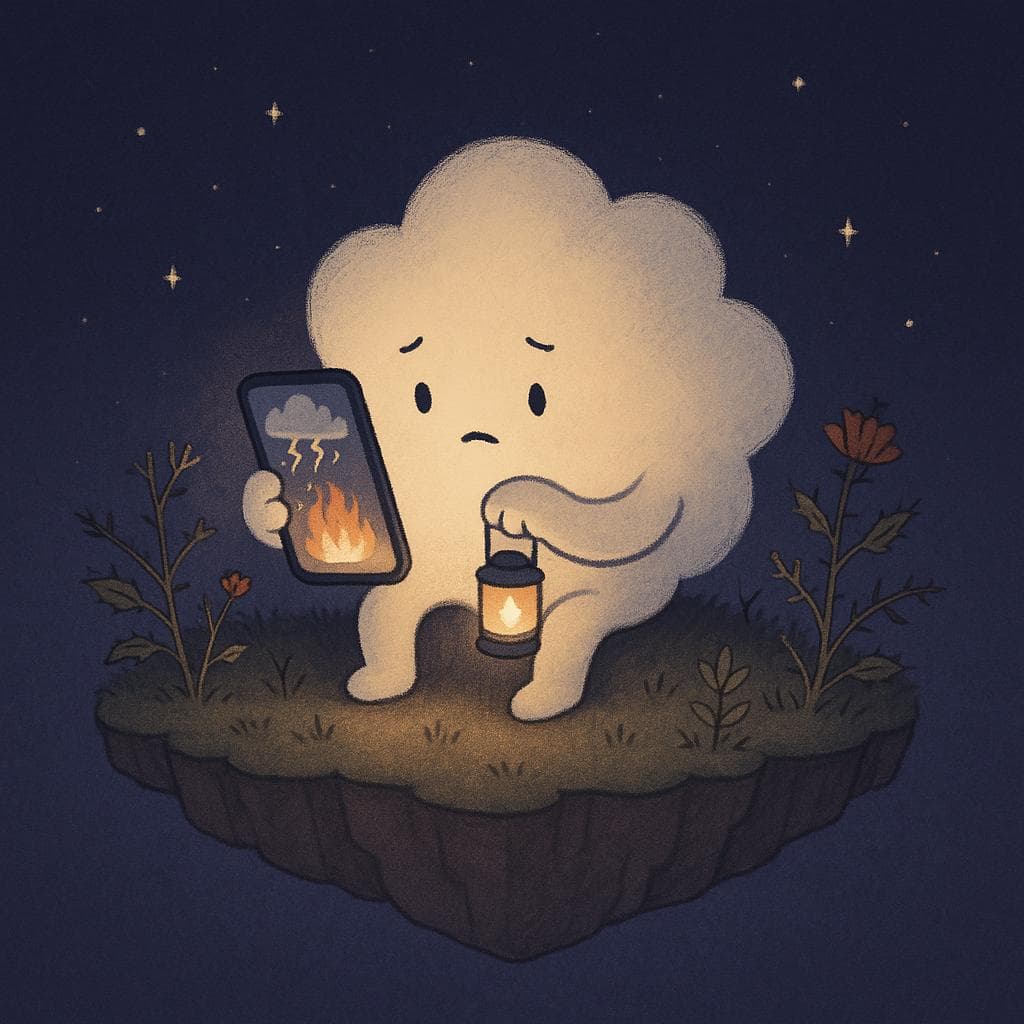
What Climate Anxiety and Existential Dread Are Really Doing to Your Brain
Your brain was not built for 24/7 global disaster feeds
Humans evolved to deal with local threats—like, “there’s a storm coming,” not “here’s a live feed of ten storms on three continents plus a melting glacier plus wildfires plus commentary threads.”
Now your phone serves you a constant stream of:
- Fires, floods, and storms
- Political inaction or denial
- People arguing in the comments about whether your future is doomed
Your nervous system basically hears: “Danger everywhere, all the time, forever.” That can trigger:
- Anxiety: racing thoughts, tight chest, restlessness
- Low mood: “What’s the point of studying, working, or planning?”
- Shutdown: doomscrolling, zoning out, or avoiding anything future-related
National data show that nearly 1 in 5 adolescents report recent anxiety symptoms (CDC, 2025). Climate is one of many reasons, but it’s a big one for Gen Z.
Why it hits especially hard if you already deal with anxiety or ADHD
If you live with anxiety, ADHD, or other emotional challenges:
- Your threat radar might already be more sensitive
- ADHD brains can hyperfocus on scary topics and spiral
- Executive function (planning, starting tasks) gets harder when everything feels meaningless
So climate anxiety doesn’t show up in a vacuum. It stacks on top of:
- Academic stress
- Money and student debt worries
- Social media pressure
- Low mood or persistent sadness
You’re not overreacting. You’re reacting with the brain and body you have, in a world that keeps handing you more to process.
Step One: Validate, Don’t Argue With Your Feelings
“Of course I feel this way” is a powerful sentence
A common trap is trying to convince yourself you shouldn’t feel anxious:
- “Other people have it worse.”
- “I’m being irrational.”
- “Caring this much is useless.”
But your brain doesn’t calm down when you shame it. It calms down when it feels seen.
Try quietly saying (or writing):
- “Of course I’m scared. The news is intense.”
- “It makes sense that I’m overwhelmed. I’m trying to plan a future in all this.”
- “I care about the world. That’s not a flaw.”
You’re not agreeing that everything is hopeless—you’re just acknowledging that your feelings are a logical response to real uncertainty.
Put dread into simple words
Existential dread loves to stay vague: “Nothing matters,” “Everything is doomed.” Vague = huge = overwhelming. Shrinking it into words can make it more manageable.
Try one of these 30-second prompts in your notes app or a physical notebook:
- “Right now, my brain is telling me that ___.”
- “I’m most scared about ___ happening in my lifetime.”
- “Climate anxiety shows up in my body as ___ (tight chest, nausea, numbness, etc.).”
If you already like journaling, you can go deeper later. If you don’t, one sentence counts. Tools like a mood journal inside a wellness app can make this even easier by giving you quick prompts and check-ins.
Step Two: Calm Your Body So Your Brain Can Think
You can’t logic your way out of climate anxiety while your nervous system is in full alarm mode. First, you help your body feel 5–10% safer. Then your brain can join the conversation.
3 tiny grounding exercises (1–2 minutes each)
-
The “Name 5” scan
Look around and silently name:
- 5 things you can see
- 4 things you can touch
- 3 things you can hear
- 2 things you can smell
- 1 thing you can taste (even if it’s just “leftover toothpaste”)
This pulls your attention out of the endless future and back into the room you’re actually in.
-
Box breathing for “my chest is tight” moments
You can do this in class, on the bus, or in bed.
- Inhale through your nose for 4 seconds
- Hold for 4 seconds
- Exhale slowly for 4 seconds
- Hold for 4 seconds
Repeat 3–5 times. That’s it. You don’t have to “empty your mind.” You’re just giving your nervous system a pattern that signals “slightly safer.”
-
Micro-movement reset
When dread makes you freeze, even a tiny movement helps.
- Stand up and roll your shoulders 5 times
- Shake out your hands for 10 seconds
- Walk to the sink, splash cool water on your face, and come back
Exercise has solid evidence for helping with anxiety and low mood in young people (Singh et al., 2025; Li et al., 2023), but that doesn’t mean you need a 45-minute workout. These little motions are still real nervous-system care.
Step Three: Set Boundaries With Climate News (Without Going Numb)
You’re allowed to stay informed and protect your emotional health. Those are not opposites.
Why endless scrolling makes dread worse
Research shows that teens who spend many hours a day on screens are more likely to report anxiety and low mood symptoms (CDC, 2024). The goal isn’t to fear your phone, but to notice:
- How you feel before you open climate content
- How you feel after
- How long it takes you to come back to baseline
If you feel wired, hopeless, or frozen after every climate thread, your brain is telling you, “This is too much, too fast.”
Simple “news boundaries” you can try
You don’t have to quit news cold turkey. Try one or two of these:
-
Pick a “climate check-in” window
- Example: “I’ll check climate news between 5–5:20 pm, not right before bed or first thing in the morning.”
- This keeps your entire day from being hijacked.
-
One trusted source > 20 chaotic ones
- Follow one or two climate journalists or scientists you trust
- Mute or unfollow accounts that only post apocalyptic vibes with no context or solutions
-
“Last scroll” rule at night
- Set a time (even just 15–20 minutes before sleep) when you stop reading heavy content
- Replace it with something low-stakes: a cozy show, fanfic, a podcast, or a short grounding exercise
If you’re using a wellness app for students like Melo Cares, you can even set a tiny daily goal like “No climate content after 11 pm” and let your garden track that boundary as a small act of self-protection.
Step Four: Make Room for Both Grief and Joy
You’re allowed to mourn what’s happening
Climate grief is real. You might be grieving:
- The future you imagined as a kid
- Places you love that are changing
- Animals or ecosystems you’ve read about disappearing
- The feeling of “safety” you never really got
Trying to skip this grief and jump straight to “positive vibes only” usually backfires. The feelings just pop up later as anxiety, numbness, or random irritability.
Tiny ways to let grief move through:
- Write a short letter to the planet, even if you never show anyone
- Draw or doodle what your climate anxiety looks like as a creature or weather pattern
- Talk with a friend and literally say, “I’m grieving the future I thought we’d have”
Naming grief doesn’t mean giving up. It means you’re being honest about what hurts.
Joy is not denial—it’s fuel
It can feel wrong to enjoy anything when the world is burning. But joy is what keeps humans and movements going long term.
Think of joy as solar power for your body:
- Laughing with friends
- Touching a tree on your walk to class
- Cooking something good with people you care about
- Watching a comfort show you’ve seen 10 times
These things don’t erase the crisis. They refill your battery enough that you can still study, organize, vote, or care about anything at all.
Step Five: Turn Panic Into Tiny, Sustainable Actions
You can’t fix the climate crisis alone. You also don’t have to do nothing. The middle path: tiny, sustainable actions that respect your energy, your schedule, and your emotional bandwidth.
Why “all or nothing” activism burns you out
A lot of climate content makes it seem like:
- You must become a full-time activist or
- You’re a hypocrite who doesn’t care
That’s not real life. You’re a person with:
- School or work
- ADHD or anxiety brain stuff
- Family responsibilities
- Limited money and time
Sustainable action looks like something you could keep doing for months, not something that destroys you in two weeks.
Tiny actions you can start this week (pick 1–3 max)
-
Learn, but in bite-sized pieces
- Follow one climate educator who explains solutions, not just disasters
- Watch a 10-minute explainer video instead of falling into a 3-hour doomscroll
-
Lower-impact habits that also help your daily life
Tiny Habit Helps the Planet Helps You Walking or biking short trips Less emissions Built-in movement, anxiety relief Reusable bottle or mug Less single-use plastic Reminds you to hydrate Eating one more plant-based meal a week Slightly lower footprint Can be cheaper if you’re broke None of these fix everything. They’re just “I care” signals that also support your wellbeing.
-
Join something local, even once
- Campus sustainability club
- Local cleanup day
- Online meeting for a climate org
You don’t have to become a leader. Just being in a (non-doom) climate space can lessen the “I’m alone in this” feeling.
-
Use your existing skills
- Good at art? Make climate-infused zines or posters.
- Into coding? Contribute to open-source mapping or data projects.
- Love writing? Share accessible explainers for friends who find the science confusing.
-
Protect your study and work time
It’s not selfish to focus on your degree or job. We need people with skills in every field in a changing world—teachers, engineers, artists, nurses, policy people, coders.
You can say: “My contribution right now is getting through this semester with my brain semi-intact.”
Step Six: When Climate Anxiety Messes With School, Work, or ADHD Focus
“Why study for a future that might not exist?”
This thought is common and really sticky. It can lead to:
- Procrastinating on assignments
- Skipping classes
- Feeling frozen when you try to plan anything long-term
Instead of arguing with the thought (“The future will be fine!”), try shrinking the time frame.
Ask:
- “What would make tomorrow 5% easier for me?”
- “What’s one thing I can do in the next 30 minutes that future-me tonight will be glad I did?”
You’re not studying for some abstract perfect future. You’re studying so:
- You have more options later, whatever the world looks like
- You can support yourself and maybe others
- You can bring your skills into a changing world, not sit on the sidelines
ADHD + climate dread = extra chaos
If you have ADHD, climate anxiety can hijack your focus:
- You sit down to write a paper, end up 2 hours deep in climate TikToks
- Hyperfocus on climate research instead of your actual assignment
- Feel guilty for not “doing enough” about the planet and also not doing enough school work
A few ADHD-friendly strategies:
-
Time-box your climate research
- “I get 15 minutes to read climate stuff, then I spend 25 minutes on my assignment.”
- Use a timer, not vibes.
-
Park your thoughts
- Keep a “climate worries” note open
- When a scary thought pops up mid-study, write one line about it and tell yourself, “I’ll revisit this during my check-in time.”
-
Make your next step laughably small
- Instead of “write paper,” try:
- “Open the doc”
- “Write one messy sentence”
- “Paste the assignment prompt at the top”
Tiny actions are how you move at all when your brain is yelling “Why bother?”
- Instead of “write paper,” try:
Apps that combine a habit tracker with gentle visuals—like a garden that grows when you complete tiny tasks—can be especially helpful for ADHD brains that need immediate, non-stressful feedback. That’s part of why Melo Cares was designed as a garden-style wellness app for college students and young adults.
Step Seven: Build a Climate-Safe Support System
You don’t have to hold this alone
A lot of young people say they’re struggling but not getting the emotional support they need. In one national survey, about 58% of adolescents said they “usually or always” get enough social and emotional support—which means a big chunk don’t (CDC, 2024).
So if you feel like you’re carrying this by yourself, that tracks.
Support doesn’t have to look like a big dramatic conversation. It can be:
- Sending a friend: “Hey, do you ever get climate anxiety? My brain is loud about it today.”
- Asking a professor or advisor: “I’m feeling overwhelmed by world events and it’s hitting my focus—are there campus supports you recommend?”
- Joining an online group that talks about climate feelings, not just climate facts
What to say if people don’t get it
Sometimes older adults or even friends might say things like:
- “You’re overthinking it.”
- “We’ve always had problems; it’ll be fine.”
- “You’re too sensitive.”
You can respond with boundaries:
- “I know you’re trying to help, but that makes me feel dismissed.”
- “I’m not asking you to fix it, I just need someone to listen.”
- “Can we talk about something else? My anxiety is already high.”
If they still don’t get it, that’s not proof your feelings are invalid. It just means they’re not your person for this topic.
Tiny 1–5 Minute Practices to Try This Week
You don’t need a perfect routine. You just need a few small actions you can repeat, like watering the same plant every morning.
Pick 2–4 of these and experiment:
-
Morning check-in (1 minute)
- Ask: “What’s my anxiety level 0–10?”
- Ask: “What’s one thing in my control today?”
- Write both down in a notes app or mood journal.
-
Midday grounding (2 minutes)
- Step outside or to a window
- Notice the sky, one plant, or even a weed in the sidewalk
- Take three slow breaths while looking at something non-digital
-
Evening “enough” list (3 minutes)
- Write 3 things you did today, no matter how small
- Example: “Answered one email, drank water, didn’t open climate Twitter after 11 pm.”
-
Scheduled worry time (5 minutes)
- Set a 5-minute timer
- Let yourself write all your climate fears without editing
- When the timer ends, close the note and deliberately shift to a different activity
-
Body kindness micro-move (1–3 minutes)
- Stretch your back against a wall
- Do 10 slow squats or calf raises
- Lie on the floor and put your legs up on a chair for one minute
If you’re using Melo Cares, you can “plant” 1–2 of these as daily actions in your garden. On days your brain says, “You did nothing,” your garden quietly shows, “You actually did tend to yourself.”

When to Consider Extra Support
This article is about self-guided coping, but sometimes climate anxiety and dread start bleeding into everything:
- You’re struggling to get out of bed or go to class
- You feel stuck in persistent sadness most days
- You’re constantly on edge or exhausted
- Basic tasks (showering, eating, answering texts) feel impossible for more than a couple of weeks
That’s a sign you deserve more support—not that you’ve failed at self-care.
If you can, consider:
- Campus counseling (we have a full guide on making the most of campus counseling services)
- Low-cost community clinics or sliding-scale therapists
- Support groups, online or in-person, focused on anxiety, low mood, or climate feelings
If you can’t afford therapy or don’t have insurance, you’re not out of options. Sometimes a mix of:
- Peer support
- Self-guided CBT-style tools (like the ones in our post on CBT techniques you can practice on your own)
- Gentle wellness apps
- Professors or advisors who understand
…can be a meaningful therapy alternative while you figure out longer-term care.
This content is for information and support—it’s not a diagnosis or a replacement for professional care. If your anxiety or low mood feels unmanageable, it’s absolutely okay to reach out to a counselor, doctor, or other trusted professional.
Bringing It All Together: Tending Your Inner Climate
Climate anxiety and existential dread aren’t problems you “solve” once. They’re more like weather patterns in your inner world—some days stormy, some days clear, most days a mix.
You can’t control the global forecast. But you can:
- Name what you’re feeling instead of silently drowning in it
- Calm your body with tiny grounding practices
- Set boundaries with news and social feeds
- Let yourself grieve and also experience joy
- Take small, sustainable actions that align with your values
- Build a support system that gets why you’re scared
Think of it like tending a small garden in the middle of a chaotic climate. You can’t stop every storm, but you can:
- Protect your soil (your nervous system)
- Water your plants regularly (tiny self-care and coping habits)
- Plant seeds of action (study, activism, community)
- Rest in the shade sometimes (joy, connection, silliness)
One next step: before you close this tab, choose one thing:
- Set a 5-minute “climate check-in” time for tomorrow
- Write one sentence about how climate anxiety feels for you
- Do 3 slow breaths while looking out a window
That’s it. One small act of tending to yourself.
You’re allowed to care deeply about the planet without burning yourself to the ground. You’re part of this ecosystem too—and you deserve care, protection, and a chance to grow, even in uncertain weather.