
Social Media and Emotional Wellbeing: What the Research Actually Says
If you’ve ever closed an app and instantly felt worse—more anxious, more behind, more “what am I even doing?”—you’re not imagining it. Social media can be a lifeline and a landmine for emotional wellbeing, especially if you’re already dealing with anxiety, ADHD, or low mood.
You’ve probably heard a lot of “social media is bad for you” takes. But what does the research actually say? And more importantly: what can you do about it without deleting every app and moving to the woods?
This is your no-BS breakdown.
Key Takeaways:
✓ Heavy social media use (3–4+ hours a day) is linked with more anxiety, low mood, and emotional challenges in teens and young adults
✓ It’s not just how much you use social media, but how you use it—scrolling and comparing hits differently than chatting with friends
✓ Moderate use (around 1–3 hours) can sometimes support connection and wellbeing when your feed and boundaries are intentional
✓ Tiny habits like muting certain accounts, setting “scroll windows,” and adding check-in rituals can protect your emotional health
✓ You don’t have to quit social media to feel better—you can redesign your digital space like a garden you actually want to hang out in
1. What research actually shows
Let’s start with what we know, not just vibes.
Screen time and mood
A lot of people worry about “too much screen time,” and the data backs up at least part of that concern.
- Teens with four or more hours of daily screen time are about twice as likely to report anxiety or low mood symptoms compared with those with less screen time (CDC, 2024).
- About 1 in 4 teenagers with four or more hours of daily screen time report recent anxiety (27.1%) or low mood symptoms (25.9%) (CDC, 2024).
That doesn’t mean “4 hours = you’re doomed.” It means that when screen time gets really high—especially if it’s mostly passive scrolling—there’s a strong pattern of more emotional struggles.
Social media specifically
Zooming in on social media:
- Children and adolescents who spend more than three hours a day on social media have roughly double the risk of experiencing emotional challenges like anxiety and persistent sadness (U.S. Surgeon General, 2025).
- In one survey, about 19% of U.S. teens said social media hurts their emotional health, while only around 9% said it helps; everyone else called it neutral (Pew Research Center, 2025).
- Nearly half of U.S. teens say they are online “almost constantly” (Pew Research Center, 2024).
- Another large youth survey suggests that moderate social media use (about 1–3 hours daily) may be linked with better emotional health than both very low and very high use (Orygen/Mission Australia, 2025).
So the picture is more nuanced than “social media = bad.” It looks more like:
- Very high use → more risk
- Very low or no use → not always ideal either (you can feel left out or disconnected)
- Moderate, intentional use → often the sweet spot
In summary, research isn’t saying you have to delete every app. It’s saying: how much you use, and how you use it, really matters.

2. Why social media hits so hard
If scrolling makes you feel anxious or empty, it’s not because you’re weak. These apps are literally designed to grab your brain.
Your brain on the feed
Social platforms are built around:
- Endless scroll – no natural “stop” signal
- Likes and notifications – tiny dopamine hits
- Algorithms – showing you what keeps you hooked, not what keeps you well
When you’re already dealing with anxiety or low mood, that combo can:
- Make you more sensitive to rejection or being “left on read”
- Feed comparison (“everyone is doing better than me”)
- Overwhelm your brain with information and emotions it can’t process
For ADHD brains, the fast pace and novelty can be extra tempting—and extra draining. You get quick stimulation, but then focusing on school, work, or even a show feels harder.
Comparison and “everyone else is fine”
Globally, low mood, anxiety and behavioural challenges are among the leading causes of difficulty in adolescents (WHO, 2025). At the same time:
- In 2023, 40% of U.S. high school students reported persistent feelings of sadness or hopelessness in the past year (CDC, 2024).
- From 2013 to 2023, that number rose from about 30% to about 40% (CDC, 2024).
So a lot of people are struggling—but that’s not what most feeds show. You mostly see:
- Highlight reels
- Perfect bodies, perfect grades, perfect relationships
- “Glow up” stories with no messy middle
Your brain compares your entire life (including the messy parts) to everyone else’s edited trailer. Of course you end up feeling behind.
Not just individual “choices”
It’s easy to blame yourself: “I should just log off.” But remember:
- These platforms are engineered to keep you there
- Your friends, clubs, and even professors may rely on social apps
- Many people use social media for activism, identity, and community
You’re not weak for getting pulled in. You’re living inside a system that makes it hard to disconnect.
In summary: Social media feels intense because it’s built to be intense—and because it’s layered on top of already-high rates of anxiety and low mood in young people.
3. When social media helps
Let’s be fair: social media isn’t all bad. For many people, especially queer, neurodivergent, or marginalized students, it’s a lifeline.
Real connection
Some upsides:
- Group chats that get you through all-nighters
- Niche communities where you finally feel understood
- Mutuals who share your ADHD, anxiety, or identity journey
- Educational creators who explain coping tools in plain language
Teens who report stronger feelings of school connectedness have lower rates of persistent sadness and substance use (CDC, 2024). While that stat is about school, the same idea applies online: feeling connected and supported matters.
If your online spaces give you:
- Honest conversations
- People who get your struggles
- Encouragement without pressure
…that can be genuinely protective for your wellbeing.
Information and validation
For many, social media is the first place they see:
- ADHD or anxiety explained in a way that finally makes sense
- People talking openly about low mood and burnout
- Language to describe what they’ve been feeling for years
That can be huge. It can also be a stepping stone toward getting more support—especially when traditional resources feel expensive or inaccessible. (If that’s you, you might also like reading about therapy alternatives when you can't afford therapy or self-care habits that take less than 5 minutes.)
Creative outlet
Posting art, music, writing, or even silly memes can:
- Give you a sense of agency
- Help you process feelings
- Build confidence in your voice
The key is whether your posting feels like expression (“I want to share this”) or pressure (“I have to keep up or I’ll disappear”).
In summary: Social media can support emotional wellbeing when it’s about genuine connection, validation, and expression—not just performance and comparison.
4. When social media hurts
So when does it tip from “this kind of helps” to “this is wrecking my mood”?
Red flags to watch for
Notice if you relate to any of these:
- You close an app and instantly feel heavier, anxious, or numb
- You start and end your day scrolling, even when you don’t want to
- You feel more lonely after being online, not less
- You compare your body, productivity, or relationships to strangers
- You can’t focus on school/work because your brain is stuck in the feed
Teen emotional challenges often show up as withdrawal from friends and family, loss of interest in hobbies, changes in sleep, increased irritability, or concerning behavior changes (CRI/MHA, 2025). For some people, that withdrawal looks like disappearing into their phone.
ADHD, anxiety, and the scroll
If you have ADHD or anxiety (diagnosed or not), social media can hit extra hard:
- ADHD focus trap: The quick dopamine of scrolling makes boring tasks feel impossible by comparison.
- Anxiety spiral: You see bad news or drama, your brain goes “what if that happens to me?” and suddenly you’re spiraling.
- Rejection sensitivity: A delayed reply or someone viewing your story but not texting back can feel like proof everyone hates you.
This doesn’t mean you’re “too sensitive.” It means your nervous system is already working overtime—and the apps are piling more on.
For more on this, you might like our post on digital detox and breaking the doomscroll habit or stress management tools that actually work for students.
Doomscrolling and low mood
Doomscrolling is that thing where you keep consuming stressful content even though it makes you feel worse.
Patterns that often show up:
- News about climate, politics, or violence that leaves you feeling helpless
- “Studytok” or “grindtube” that makes you feel lazy no matter what you do
- Body/beauty content that slowly erodes your self-esteem
Over time, this can feed:
- Persistent sadness and hopelessness
- Feeling like nothing you do matters
- Emotional numbness or shutdown
In summary: Social media starts to hurt when it’s more about numbing, comparing, and doomscrolling than connecting, learning, or expressing.
5. Tiny ways to protect your feed
You do not have to overhaul your life to make social media less toxic. Start with tiny, 1–5 minute tweaks.
Clean up your garden
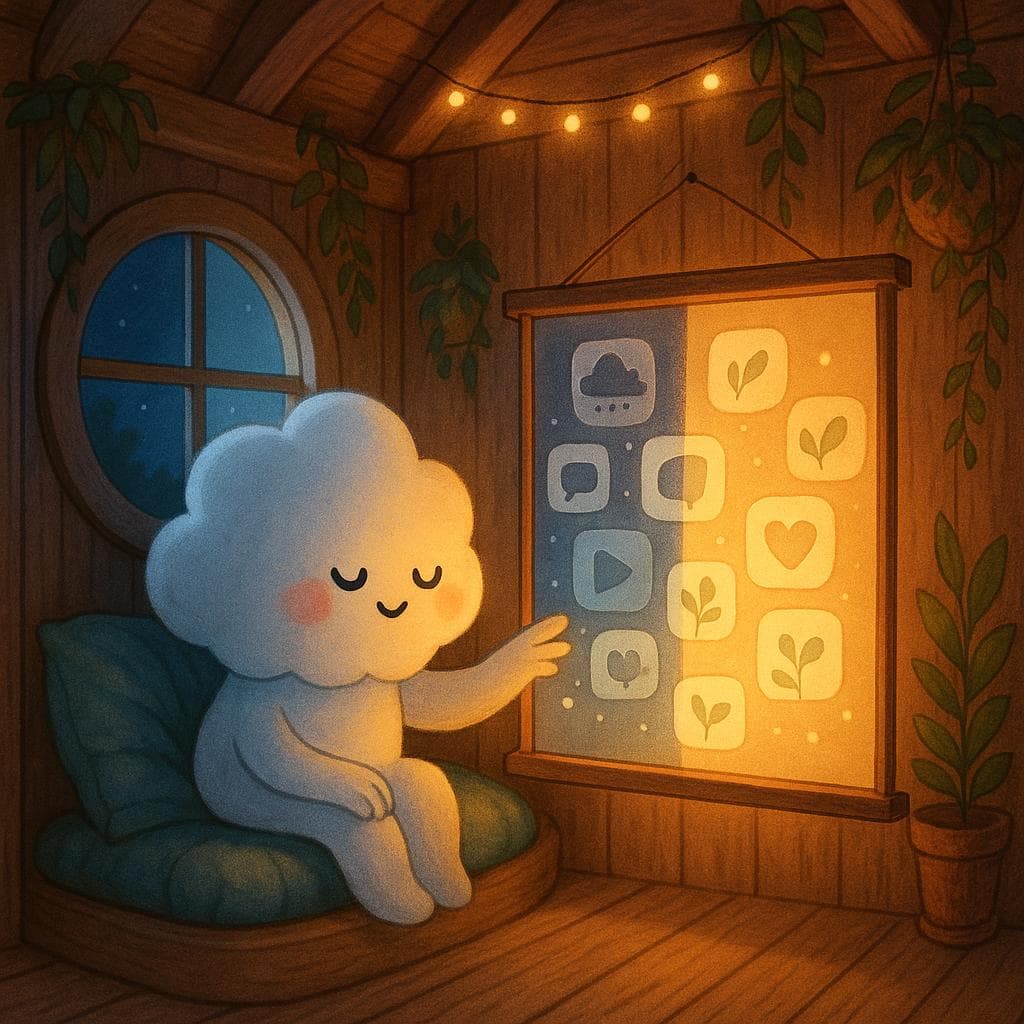
Think of your feed like a garden. You can’t control the weather (algorithms, trends), but you can choose what you plant and what you pull out.
-
Mute, don’t debate
- Mute accounts that consistently make you feel bad about your body, grades, money, or lifestyle.
- You don’t owe anyone an explanation.
- This takes 10 seconds and can change your whole vibe.
-
Add more “green” content
- Follow accounts that:
- Make you laugh without punching down
- Teach skills (cooking, studying, budgeting)
- Normalize rest and realistic lives
- Sprinkle in creators who show messy, real days—not just aesthetic perfection.
- Follow accounts that:
-
Separate “fun” from “news”
- Keep at least one app mostly for friends/memes.
- If you want news, choose one or two intentional sources instead of letting the algorithm pick for you.
Time boundaries that don’t suck
You don’t need perfect discipline. You need gentle guardrails.
| Goal | Tiny action (1–3 min) | Why it helps |
|---|---|---|
| Less late-night anxiety | Set a “no scroll in bed” rule 3 nights a week | Protects sleep and racing thoughts |
| Fewer random check-ins | Create 2–3 “scroll windows” per day | Reduces constant distraction |
| More mindful use | Ask “why am I opening this?” once a day | Builds awareness, not autopilot |
| Softer mornings | Wait 10 minutes after waking before opening apps | Lets your brain land in your own life |
Example:
You wake up, your hand grabs your phone on autopilot.
Instead of opening TikTok, you open your notes app and type one line:
“Today I feel ___.”
Then you stretch, drink water, then decide if you want to scroll.
That’s already a boundary. It counts.
Check in with your body
Once a day, mid-scroll, pause and ask:
- How’s my chest? Tight, heavy, neutral?
- How’s my jaw? Clenched or relaxed?
- How’s my mood? Up, down, numb?
If the answer is “worse than before I opened this,” that’s your cue to:
- Close the app
- Stand up
- Take three slow breaths
- Look at something that’s not a screen (out a window, at a plant, at the ceiling)
It’s okay if you reopen the app later. You’re just adding tiny moments of tending to you, not just your feed.
6. Building a healthier digital routine
Over time, these tiny shifts can turn into a gentle digital wellness routine—no perfection required.
Think “re-balance,” not “quit”
Instead of “I have to quit social media,” try questions like:
- “How do I want to feel when I’m online?”
- “What kinds of content actually leave me calmer or inspired?”
- “What’s one small boundary that would make my day 5% easier?”
You’re not ripping out the whole garden. You’re pruning, replanting, and adding a few more shaded spots.
Pair scrolling with care
If you’re going to scroll (and you probably are), pair it with something that supports your body:
- Scroll while:
- Sitting with your back supported instead of hunched
- Drinking water or tea
- Doing a simple stretch every few videos
- Or make a rule: “Every time I close this app, I do one tiny act of care”:
- Put on chapstick
- Stand up and shake out your hands
- Write one word about how you feel
You’re training your brain to associate digital time with at least some physical or emotional care.
When to consider extra support
If you notice:
- Your sleep is consistently wrecked by late-night scrolling
- You feel persistent sadness or hopelessness most days
- You’re withdrawing from friends, hobbies, or school because you’re so drained
…that’s a sign it might help to talk to someone—like a counselor, therapist, or trusted adult. Many campuses have counseling centers, peer support groups, or wellness workshops, even if they’re not perfect. You deserve support that goes beyond “just log off.”
This article is here for education and ideas, not as a replacement for professional care. If your emotional struggles feel heavy or long-lasting, reaching out for personalized support is a strong and valid move.
7. Conclusion
Social media isn’t just “good” or “bad” for emotional wellbeing—it’s powerful. Research shows that:
- Heavy use (3–4+ hours a day) is tied to more anxiety and low mood
- Moderate, intentional use can support connection and even help you feel less alone
- The way you use it—who you follow, when you scroll, how you feel afterward—matters more than any one rule
Your feed will never be perfect. But you can:
- Gently prune what drains you
- Add more accounts that actually feel like sunshine
- Build tiny check-ins and boundaries that protect your energy
One concrete next step: today, mute or unfollow three accounts that reliably make you feel worse, and follow one that makes you feel seen, calm, or genuinely entertained. That’s it. That’s tending to your digital garden.
If you want a softer place to track how these tiny changes affect your mood—and grow small habits that exist outside the algorithm—you can download Melo and start turning those little actions into a garden that reflects your real progress, not your follower count.